Citizens Advice reveals how to save struggling households £950 a year through reformed bill support
Citizens Advice reveals how to save struggling households £950 a year through reformed bill support
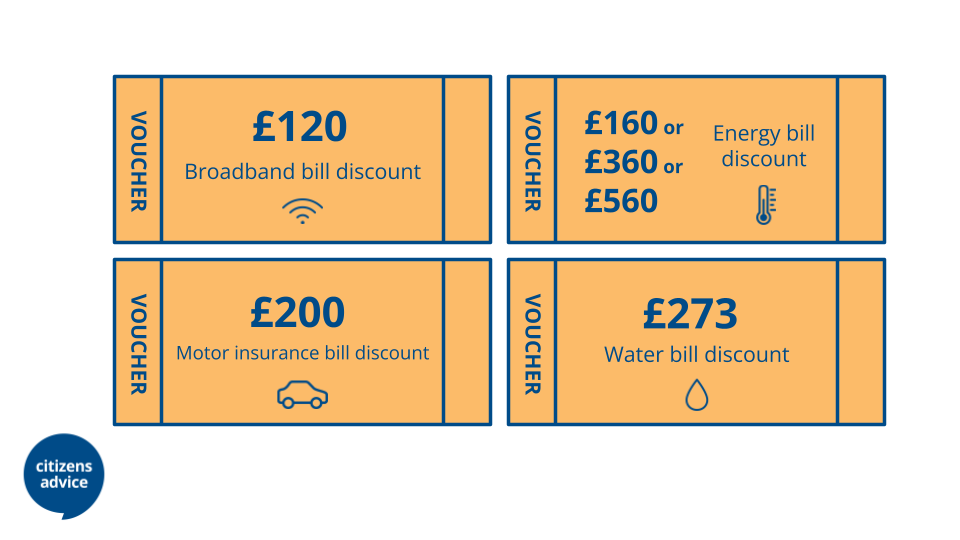
As people across the country battle an unrelenting living standards crisis, Citizens Advice has revealed reforming bill support across essential markets, including energy and water, could save eligible households a staggering £950 a year. That’s the equivalent of £79 a month, which amounts to an income boost of almost 6% for low-income households.
Citizens Advice’s solution for energy bills alone - to expand the existing Warm Home Discount - would help 5.6 million households save an average of £360 a year. For water, its recommendations to bring in a new, single social tariff - a discounted bill for those who need it - could see 1.9 million households receive a £273 discount each year. It could also pull over half a million (580,000) households out of water poverty.
These latest findings come from the Institute for Public Policy Research (IPPR), as part of a Citizens Advice led-partnership with IPPR and Policy in Practice, looking at improving targeted bill support. The work is focused on regulated markets where social tariffs or targeted bill-support schemes already exist but fall short - energy, water and broadband - and is also examining motor insurance given recent price volatility. Because each market is different, a one-size-fits-all approach won’t work; tailored solutions are needed to ensure support truly meets people’s needs.
Big savings for an eligible household
| Essential bill | What better bill support would look like | Impact | How it would be funded |
|---|---|---|---|
|
Essential bill
Water |
What better bill support would look like
A single water social tariff, for households with incomes less than £300 per week, or those in water poverty. |
Impact
1.9 million households save £273 each year, meaning over half a million (580,000) households pulled out of water poverty. |
How it would be funded
Industry funds bill support, potentially using bill increases or other cost-savings. |
|
Essential bill
Energy |
What better bill support would look like
Expand the Warm Home Discount to provide tiered support to different household energy needs. |
Impact
5.6 million households save an average of £360 a year, meaning 600,000 households no longer spend 10% of their income on energy bills. |
How it would be funded
His Majesty’s Treasury funds any additional bill support beyond the existing Warm Home Discount. |
|
Essential bill
Broadband |
What better bill support would look like
Introduce a new £10 a month voucher for targeted broadband bill support to households receiving means-tested benefits with an income of less than £300 per week. |
Impact
Internet more affordable for 1 million eligible households. Eligible individuals save £120 a year.
|
How it would be funded
Industry funds bill support, potentially using bill increases or other cost-savings. |
|
Essential bill
Motor insurance |
What better bill support would look like
Introduce a new £200 a year voucher to reduce the cost of motor insurance for people on means-tested benefits. |
Impact
Motor insurance more affordable for 3.2 million eligible households. |
How it would be funded
Industry funds bill support, potentially using bill increases or other cost-savings. |
Change can’t come soon enough
These recommendations follow Citizens Advice’s warning that four million people can’t afford essentials, and that the living standards crisis is set to worsen without urgent action.
The charity has also seen the need for targeted bills support growing. So far this year, Citizens Advice has helped 45,000 people with water social tariffs, including WaterSure, (up 13% on the previous year), 30,000 people with the Warm Home Discount and 26,000 people with broadband social tariffs (up 21% on the previous year).
With its latest findings revealing the potential of improved bill support, Citizens Advice is urging the government and suppliers to act now to prevent people spiralling into debt or facing desperate decisions about how to cut back further each month. The charity wants to see any eligible households automatically enrolled for bill support, so nobody misses out.
Dennis’s story: I didn’t know help was out there
Dennis is in his late 50s and lives in Bristol. He worked as a tiler for 40 years, earning a good income. However, after facing skin cancer for a second time three years ago, Dennis was left unable to work. Dennis lived on his savings until they were exhausted, sold his van and possessions to pay bills, but fell into debt and rent arrears that left him worried he might be evicted and made homeless.
We helped Dennis apply for the benefits he’s eligible for, and to renegotiate his energy and water bill payments with suppliers. He successfully applied for a social tariff, reducing his water bill dramatically, and advisers helped arrange for a local charity to settle £280 of outstanding energy debt.
“I had heard of social tariffs but I thought they were for pensioners, or severely disabled people.” said Dennis. “I've borrowed from family members, only for bill money. I owe them around £3,000. If I'd known to put in the paperwork I wouldn't have got in that situation.
“If there was more support with bills available, it could help save you before you slip. The system as it is, let me fall as far as I fell, not because I’m useless but because I was ill and didn’t know help was out there. Citizens Advice scooped me up but a better system might prevent people from falling in the first place.”
Dame Clare Moriarty, Chief Executive of Citizens Advice said:
“With punishingly high bills across the board, it’s inevitable that people are cutting back on essentials, getting into serious debt or facing impossible choices. But the government and suppliers are not powerless in this situation.
“Reforming bill support across essential markets has the potential to protect millions of people from unwavering financial pressure.
“Anyone could find themselves needing a safety net if their circumstances change, and we know from the people our advisers speak to every day just how urgently action is already needed. Nobody should be unable to afford essentials like energy or water. The government must act now.”
Henry Parkes, Principal Economist at IPPR, said:
“Right now, the cost of living is the public’s number one priority - and that means the government must wage a serious war on rising bills. No one should be choosing between staying warm, having clean water, or staying connected. Sensible, targeted bill support could lift hundreds of thousands of households out of hardship and put money back into the pockets of those who need it most.”
Deven Ghelani, Founder of Policy in Practice said:
“Rising bills mean more people are needing to navigate a fragmented network of support. This report shows how policymakers can make schemes easier to navigate, even auto-enrolling a growing number of households, ensuring support gets to those households who are struggling the most.”
-ends-
For more information contact: press.office@citizensadvice.org.uk
Tel: 03000 231 080
Out-of-hours contact number: 0845 099 0107
We give people the knowledge and confidence they need to find their way forward - whoever they are, and whatever their problem.
Notes to editors:
In partnership with the Institute for Public Policy Research (IPPR) and Policy in Practice, Citizens Advice is undertaking a research project to build a blueprint for how the government can best harness the potential impact of bill support to solve the cost-of-living equation for struggling households - in both the short and longer-term.
Essential bills in this release refers to energy, water, broadband and motor insurance bills. The project is focussed on these four bills as these sectors are regulated markets, where social tariffs or targeted bill support schemes either exist in some form already but need improving (energy, water, broadband), or are good potential candidates for bill support in light of recent price volatility (motor insurance).
Modelling is built using data from the IPPR tax-benefit model with the Living Cost and Food Survey (LCFS) to transform data from the LCFS from 2018/19 – 2022/23 to “now-cast” for the current 2025/26 financial year. The distributional analysis uses equivalised income. All other income is not equivalised.
Modelling for energy, motor insurance and broadband bill support is for Great Britain. Modelling for water bill support is across England and Wales.
To achieve the anticipated average annual saving of £950, a household would need to be eligible for proposed targeted bill support across all four markets. The £950 is a rounded total of £120 discount for broadband, £360 discount for energy, £200 discount for motor insurance and £273 discount for water. The net average bill reduction would be slightly lower than the discount amounts because the cross-subsidy of schemes across all bill payers would slightly increase bills.
This modelling was completed prior to the Autumn 2025 Budget, and therefore the baseline does not account for changes announced during the Autumn Budget, including changes to the two-child benefit cap or Energy Company Obligation (ECO) scheme.
The full report offers more detail on proposed funding mechanisms and how different funding can impact metrics such as water poverty and energy affordability.
The potential impact on an eligible household’s income- “income boost of almost 6% for eligible low-income households” is calculated as a 5.55% increase using the net average weekly discount total for all four vouchers (£17.31) from the £312 average weekly income for low-income households.
A household would need to be eligible for all schemes to receive the average total discount.
The £312 average weekly income is taken from the weekly net equivalised disposable household income before housing costs for the 10th percentile in the 2024 financial year from the Department for Work and Pensions’ Households Below Average Income (HBAI) report.
The calculation is based on the income of a couple with no children in the 10th percentile of equivalised income before housing costs. The discounts outlined would represent a bigger increase in percentage terms if it was a single adult household or a smaller increase for a couple with children.
Water poverty is defined as spending more than 5% of household income on water bills after tax and housing costs, as per CCW guidance.
The impact of a single water social tariff- “1.9 million households save £273 each year. Over half a million (580,000) households pulled out of water poverty” is predicated on the assumption that existing local schemes remain, rather than are replaced.
Data taken from Casebook (Citizens Advice’s case management system for its advice services across England and Wales) on 3rd November 2025 reflecting client cases between 1st January and 31st October 2025. The charity has helped 44,503 people with water social tariffs (including WaterSure), 29,850 people with the Warm Home Discount and 26,209 people with broadband social tariffs. For water social tariffs, this is 13% more people coming for help than the same period last year (39,522 people). For broadband, this is 21% more people (21,747 people in the same period last year).
Citizens Advice is made up of the national charity Citizens Advice; the network of independent local Citizens Advice charities across England and Wales; the Citizens Advice consumer service; and the Witness Service.
Our network of charities offers impartial advice online, over the phone, and in person, for free.
Citizens Advice helped 2.68 million people face to face, over the phone, by email and webchat in 2023-24. And we had 51.7 million visits to our website. For full service statistics see our monthly publication Advice trends.
Citizens Advice service staff are supported by more than 19,000 trained volunteers, working at over 1,900 service outlets across England and Wales.
Citizens Advice is the statutory consumer advocate for energy and postal markets. We provide supplier performance information to consumers and policy analysis to decision makers.
You can get consumer advice from the Citizens Advice consumer service on 0808 223 1133 or 0808 223 1144 for Welsh language speakers.
IPPR (the Institute for Public Policy Research) is an independent charity working towards a fairer, greener, and more prosperous society. We are researchers, communicators, and policy experts creating tangible progressive change, and turning bold ideas into common sense realities. Working across the UK, IPPR, IPPR North, and IPPR Scotland are deeply connected to the people of our nations and regions, and the issues our communities face. We have helped shape national conversations and progressive policy change for more than 30 years. From making the early case for the minimum wage and tackling regional inequality, to proposing a windfall tax on energy companies, IPPR’s research and policy work has put forward practical solutions for the crises facing society. www.ippr.org
Policy in Practice sets out to make government policy simple to understand, empowering people with the clarity and confidence they need to make positive decisions. As a team of policy experts, we have developed services including the BetterOff calculator on GOV.UK and the Low Income Family Tracker to help individuals and organisations to overcome departmental silos and help people to tackle rising living costs and build resilience.