Deliver at all costs: How insecure pay and conditions for delivery drivers are failing parcel consumers
On this page
- Executive summary
- Background and methods
- Key findings 1: Driver pay and conditions incentivise prioritising speed and volume over service quality
- Key findings 2: Current working practices are having direct consequences for consumers
- Next steps: Regulatory fixes and employment reforms are both needed
- Endnotes
Executive summary
Now a staple of UK retail, parcel deliveries help many of us access everything from luxury goods to medicines. Online shopping made up 27.4% of all retail value in Great Britain last year and employment in the sector has grown rapidly as a result - the Recruitment and Employment Confederation identified delivery drivers and couriers as one of its top three occupations for vacancy growth in July 2026.
But rates of consumer problems in this market remain strikingly high. Over five years of monitoring, we’ve never seen fewer than 1 in 3 people have an issue with their latest home delivery. Parcels are frequently left on doorsteps or in insecure places, arrive damaged, or go missing. [1] Disabled people struggle to secure accessible deliveries. [2] And this lack of progress is also mirrored in Ofcom’s market monitoring data.
In 2023, Ofcom introduced new rules to address this high rate of detriment, strengthening standards around accessibility and introducing new guidance on complaints processes. Yet, the evidence has shown little impact on the ground. In February, the regulator wrote to parcel companies highlighting the need to address this.
But new guidance may be missing the mark because it overlooks a crucial factor: the role played by employment conditions prevalent in the parcels market. A significant proportion of the growing numbers of delivery drivers are self-employed. They face variable pay and insecure contracts which create intense pressure to prioritise speed - often at the expense of service quality.
This is creating a disconnect between what people want from their parcel services and the models used in practice. Previous research we’ve conducted found that consumers prioritise reliability over speed for their parcel deliveries - our polling showed that 21% of consumers pick reliability as their number one priority (compared to just 9% for speed). [3] However, consumers rarely get to choose the carrier which delivers their purchases, limiting their ability to express these priorities and punish poor performers.
With minimal evidence on the conditions that shape self-employed delivery drivers’ goals and incentives publicly available, we commissioned Spark Insight to look at the role of driver working conditions and their impact on consumer outcomes in more detail. Based on a survey and interviews with 50 self-employed delivery drivers, we find that:
Driver payment models operate on highly pressurised targets and very low margins. Only a quarter of the 50 self-employed drivers earned the equivalent of the National Minimum Wage (NMW) or above, after accounting for running costs and unpaid time spent working. Drop-off targets left an average of just 3 minutes 9 seconds for each delivery.
These working practices have consequences for consumers. The clear incentive for many couriers is to leave the item as quickly as possible, with little regard to whether a customer has time to get to the door or whether the location is fully secure. Three quarters of drivers agreed that ‘the pressure to deliver quickly makes it difficult to provide good customer service”.
Employment models are a particular barrier to meeting new accessibility standards. Time margins are not sufficient for drivers to meet any additional delivery requirements for disabled consumers. Just one of 50 drivers had received training on accessibility needs.
How do we fix this?
A third or more of people facing problems with their latest delivery isn’t acceptable. But if delivery reliability is to improve, any solutions must address the employment and pay models that drive these outcomes. This involves looking at the interaction between regulation and employment law.
The regulator, Ofcom, should consider the role of essential and consumer protection conditions - applied to parcel carriers - in offering clear incentives for companies to ensure their drivers can meet good service standards.
The Department of Business, Innovation, Science, and Trade (DBIST) can reform employment law, to sharpen the distinction between self-employed and employee status. It can also ensure clear routes to enforcement where companies misclassify their staff.
We need to see action in both areas to effectively recalibrate business models so they better meet the needs of consumers and drivers.
Ofcom should strengthen Consumer Protection Condition 5.
This requires parcel companies to establish, publish and comply with clear and effective policies for the fair treatment of disabled consumers. Ofcom should strengthen this condition to ensure that companies' payment models allow additional time to be factored in for drivers to meet accessibility needs. The regulator should also ensure that requirements around training on accessibility apply to all drivers, regardless of employment status.
Ofcom should apply Essential Condition 1 to all parcel operators.
This requires operators to ensure secure delivery and report performance data, addressing some of the most common delivery issues around parcels dropped on doorsteps or in insecure locations. It currently only applies to Royal Mail as the Universal Service provider, but should be extended to drive higher standards across the market.
The Government/DBIST should implement a Single Worker Status, and ensure there are effective routes to status enforcement.
This would sharpen the distinction between employees and those who are genuinely self-employed. In the parcels market, this would likely mean more drivers regularly doing delivery rounds would be engaged as employees, and therefore better protected from the tight targets and payment models which too often prioritise speed over quality and security. DBIST should also investigate the employment models and conditions in the parcels sector without delay.
Background and methods
The following report summarises the findings of this new research, bringing them together with Citizens Advice’s suggestions for action. You can find Spark Insight’s report with fuller detail on the research findings here 947 KB .
First, this report covers background, including the latest market monitoring data on delivery issues and recent regulatory developments. Second, it outlines the methodology and the sample of self-employed drivers who took part in the research. Then, it presents the findings in two key sections: Section 1 focuses on how pay structures, high targets, and low wage rates combine to prioritise speed and volume over service quality; Section 2 examines how these working practices impact consumers. Finally, Section 3 draws these findings together into a conclusion and sets out routes to achieve a better market for both consumers and workers.
Getting to the bottom of people’s doorstep delivery problems
Booming during the pandemic and with demand remaining high, parcel deliveries are now a core part of UK retail. In 2024–25, we sent and received a record 4.2 billion parcels. This makes parcel delivery a key service for consumers, as well as a crucial foundation for business growth.
Yet the growing importance of the industry has not led to improved customer experience. Parcels left on doorsteps, in hedges, even in bins. Parcels delivered to the wrong address. Drivers leaving before you have time to get to the door, or not knocking at all. These are all-too-familiar frustrations we hear through our monitoring of the parcels market - with 1 in 3 people having had an issue with their latest delivery.
“The parcel was put in the recycle bin and was taken away in the rubbish”
“Left on step at front door - I am 78 and could not lift it in”
“Thrown over wall into back garden”
“I was home, but driver didn't ring doorbell”
“It was left in a bush near my house, was wet and in bad shape”
- People surveyed about their latest parcel deliveries in our 2025 parcel league table
These problems can mean loss or damage of an important or valuable item, and time spent searching for a parcel or trying to resolve the issue. But they can be especially harmful to people with accessibility needs, who may both struggle to retrieve parcels and also rely more heavily on deliveries for day-to-day needs.
Ofcom introduced new rules to address this growing incidence of consumer problems, strengthening standards around accessibility and introducing guidance on complaints processes in 2023. However, both Ofcom’s monitoring and our own show no progress on bringing down persistently high rates of issues.
When people are asked about their priorities for parcel deliveries, our evidence finds reliability is a key priority. Polling we conducted last year found that 21% of consumers put reliability as their number one priority (compared to just 9% for speed). Last year, our focus groups also showed that a more reliable parcel service, even at a slightly higher price, was unanimously preferred over a more inconsistent service at a lower cost.
But consumers lack the power to vote with their feet in this market. Retailers choose the parcel delivery company, and their priorities may differ from consumers’. In this context, it is especially important that the rules set by the regulator are designed to effectively secure outcomes needed by those who rely on parcel services.
In February 2026, Ofcom wrote to all parcel companies expressing concern that their new rules have failed to deliver real improvements. The regulator stated it will consider “whether enforcement action is necessary or additional regulation is needed to ensure consumers are adequately protected”.
While the regulator is clearly already engaged in this issue, we want to ensure that they are not overlooking the role played by employment practices.
Self-employment in the parcel sector
The UK parcel delivery sector relies heavily on insecure, self-employed workers. At the same time, companies do not openly publish information regarding the pay, employment conditions, or incentive structures applied to their self-employed workforce. Therefore, this research set out to explore these practices and examine their relationship to consumer outcomes.
Unlike employees, self-employed delivery drivers have different and more limited rights. They have:
No legal entitlement to National Minimum Wage (NMW), sick pay, holiday pay, or pension entitlements
Financial responsibility for running costs, including fuel and vehicle maintenance
No guaranteed work, alongside the right to refuse shifts or supply a substitute driver
While employees are typically paid for set working hours, parcel delivery companies often pay self-employed drivers per ‘block’ of time or per parcel delivered. This practice fundamentally alters the relationship between time and work, particularly the incentives to prioritise quantity of parcels delivered over the quality of the service provided.
For companies, using self-employed drivers offers a number of advantages. As employers, they don’t have to pay for a range of employment benefits, and the lack of guaranteed hours allows them to scale work hours up or down flexibly. For workers, being self-employed theoretically allows for flexibility around hours and the right to refuse shifts.
However, there are also concerns around ‘bogus self-employment’ in the UK labour market generally, and in the parcel delivery sector. This is where workers are classified as self-employed and denied basic labour rights, yet remain subject to employee-style controls and restrictions. While this research was not designed to explicitly identify bogus self-employment, several findings do raise important questions for further investigation into how genuinely self-employed workers in the parcels sector really are.
Instead, this research focuses on pay and working conditions, and their direct relationship to service quality. Although self-employed workers are not legally entitled to the NMW, it is used as a benchmark against which to evaluate drivers' actual take-home pay after accounting for work-related expenses. This is because the NMW reflects the wage normally required to cover basic costs and living standards.
Research methods
We commissioned Spark Insight to conduct research with 50 self-employed delivery drivers in England and Wales. The research aimed to understand self-employed drivers’ pay and working conditions, and how these impact their ability to provide a high-quality service at the doorstep. It has two elements:
Small-scale quantitative evidence on pay, working time, and running costs
Qualitative driver feedback on how the payment model creates pressure on them and affects delivery quality
Drivers first completed an online survey, collecting self-reported information on their pay, running costs, working time, and experiences of work. At the end of the survey, 31 drivers submitted documentary evidence of their pay, such as screenshots of completed shifts, invoices, and rate cards.
Researchers then conducted 30-minute interviews to check the information provided, and explore drivers’ experiences of work and its impact on consumer outcomes in more detail.
Self-employed delivery drivers are a hard-to-reach and time-poor group, so conducting a large-scale, statistically representative survey was not feasible. However, the strength of this approach lies in how initial survey data on pay, costs, and working hours could be cross-checked with follow-up interviews – and in the case of 31 drivers, against documentary evidence. Where initial figures from the survey seemed inconsistent, this multi-step approach allowed the opportunity to probe further and ensure the estimates in this research are as accurate as possible.
Given that data on pay, hours and costs are not systematically recorded, drivers had to estimate costs in some cases. Participants sometimes gave these in ranges, and in these cases, the midpoint was used in average calculations. Therefore, findings should be treated as robust estimates rather than firm figures because of the small sample size and self-reported nature of the data. Although the quantitative findings are not statistically representative, this approach provided a practical and effective way to gain as deep an insight as possible into the various different payment and cost models operating in this sector given the constraints.
Sample overview
The research sample was designed to be broadly representative of the self-employed parcel delivery workforce. All participants carried out final-mile doorstep delivery and the participants included:
10 women
8 mainly driving rural routes, 19 mainly urban, 23 mainly suburban
29 racially minoritised drivers
41 drivers in England and 9 in Wales
8 drivers who had additional benefits as part of their self-employed contracts
The sample also included drivers hired and managed by third party intermediaries (TPIs), which are subcontracted delivery fleets. These companies engage and manage their own self-employed drivers to fulfill contracts with parcel operators. They are a common feature of the UK parcel delivery workforce.
Key findings 1: Driver pay and conditions incentivise prioritising speed and volume over service quality
The first clear finding emerging from the research was the distinct set of working conditions shaping self-employed drivers’ experiences and incentives. Pay structures, high delivery targets, and low wage rates combine to push drivers to prioritise speed and volume over service quality – and also place drivers under a lot of pressure.
Payment models are designed to prioritise speed and volume targets over service quality
Delivery drivers in this sample were most commonly paid per parcel (55%) or for a set block of time (33%). The remaining 12% received another form of payment, most frequently a day rate.
Self-employed drivers collect a fixed number of parcels from a depot, but aren't paid according to how long it takes to deliver that round - even if the shift takes longer than the given or expected timeframe. This means pay is directly linked to speed - the longer it takes them, the lower their effective hourly pay.
For drivers paid per block, high targets can mean that they have to continue working long past the allotted time they’re actually being paid for.
And for those paid per parcel, low pay per package and high volumes require them to work extremely quickly so that total drop-offs add up to a viable hourly wage.
Some self-employed drivers are only paid for ‘successful’ deliveries, where the parcels have been marked as dropped off, so any re-delivery attempts or returns to the depot are unpaid.
Certain participants also mentioned incurring financial penalties if they don’t complete all their deliveries on target - for example, some were subject to £10-£25 daily deductions for late deliveries or incomplete rounds where deliveries were not attempted.
A number of participants raised concerns about losing shifts, their regular routes, or future work if they didn’t meet targets. As drivers on self-employed contracts also don’t have rights to guaranteed ongoing work, this contributed to the pressure to drop all their parcels.
"Whatever happens, your standing always goes down. So, they tell you if your time finishes, you don't have to continue delivering. But you take it back to the delivery place and then two days later your standing will go down because you didn't deliver those."
- Parcel delivery driver
"If you return parcels back to the warehouse, then they'll just be like, 'why have you returned so many?' And it will sort of be within your profile, it'll be written down as a negative...You'll probably be refused shifts. You won't be as required as maybe the others who are more competitive.”
- Parcel delivery driver
The combination of these payment practices and job insecurity create strong financial incentives for drivers to prioritise speed, and leaving the parcel at the delivery location on first attempt, regardless of circumstances.
Volume targets can be challenging
Payment models designed to incentivise drivers to work at speed also operate on targets for high volumes of parcels per round. Delivery targets will naturally vary depending on context, including the distance between drop-off locations, and not all drivers in the survey felt their targets were too high. When asked how many parcels drivers were typically expected to deliver, targets varied significantly across the sample, from 4 to 50 parcels per hour.
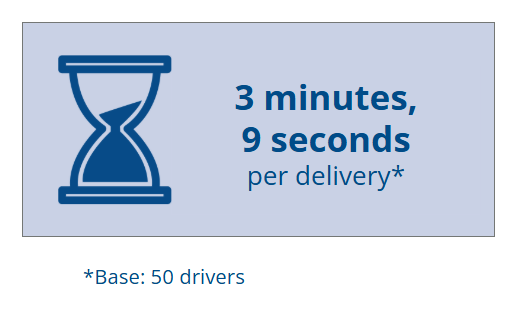
On average, targets amounted to 19 parcels per hour - leaving just 3 minutes 9 seconds for each delivery.
Of the 50 survey respondents, just under half (47%) stated that they are satisfied with their delivery targets, around a third (31%) gave a neutral response and just over one in five (22%) said that they are dissatisfied. However, increased pay is dependent on higher targets for drivers who are paid per parcel, so this potentially influences how drivers feel about them.
During the qualitative interviews, a polarised view on targets emerged. While some drivers reported they could manage their volumes due to their experience and familiarity with their route, a number stated that the volume of parcels they are expected to deliver is very challenging to achieve.
"The company I work for, the route that they've given you and the amount of parcels, it's basically impossible to finish. But then, if they don't think you're gonna finish, they'll send someone out to come and collect some parcels off you and, however many they take, they deduct a pound a parcel from your actual day rate that you're supposed to earn."
- Parcel delivery driver
Nonetheless, just over 3 minutes provides very little time to travel between drop off locations, find the correct parcel, ring the doorbell, and wait for the customer to answer.
Drivers’ earnings are extremely low after accounting for running costs and unpaid time
Unlike standard employees, those who are self-employed normally have to factor in wider costs to their earnings. Self-employed delivery drivers must cover their own running costs, for example. Self-employed drivers also frequently worked past their allotted or expected timeframes without receiving any additional compensation and spend time on tasks they do not feel are accounted for in how they are paid, such as vehicle loading, processing returns, or managing unexpected road delays.
We wanted to understand how driver pay stacks up once running costs and unremunerated hours are factored in – comparing these figures against the NMW (£12.71) that regular employees are legally entitled to receive. This comparison looks at pay before tax deductions, [4] and does not factor in the impact of bonuses or penalties, given the conditional and ad hoc basis on which these are levied.
Based on self-reported data from 50 self-employed drivers, average pay after running costs and unpaid working hours is extremely low:
Average gross pay was £15.26 per hour, ranging from £6.92 to £24.62.
Average pay fell to £14.93 per hour when unpaid working hours were factored into the calculation.
Running costs averaged £146.14 per week, absorbing on average just under one-third (31%) of gross pay.
Average pay after deducting both running costs and unpaid time dropped to £10.36 per hour. The median was £10.91 per hour.
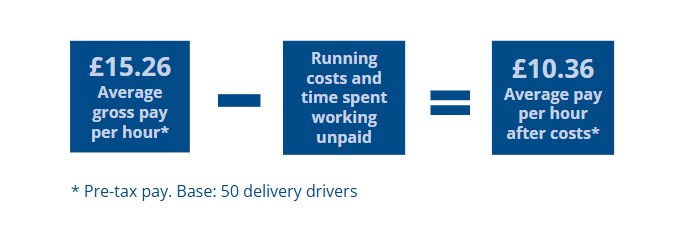
Only one quarter (25%) of the 50 self-employed delivery drivers in this research earned the NMW equivalent for the total hours they work, after running costs. As mentioned, this comparison looks at pre-tax pay, and neither does it take into account the value of sick pay, holiday pay, and pensions, which self-employed drivers have to fund. [5]
The interviews revealed that many drivers were not in the routine of calculating their pay against running costs or unpaid time. Instead, they tended to view their earnings in terms of weekly or monthly gross payouts. This is concerning, as drivers may be unaware of how low their effective hourly earnings are.
At the same time, some participants worked exceptionally long hours. While half the drivers in the research worked part-time, those working full-time (35 hours or more) averaged just over 47 hours per week. Furthermore, nearly half of 25 full-time drivers (48%) reported averaging more than 48 hours weekly.
“I'm on the bare minimum with two jobs because of the cost-of-living crisis. I think I'm down by £150 a week given the amount of work I do [referring to unpaid time]. My round is quite large and has one of the largest volumes of a single round and my continuity is high which should be rewarded."
- Parcel delivery driver
These findings are worrying from a living standards perspective – a number of participants reported struggling to make ends meet on their earnings from delivery driving alone. Within this context, it’s clear that self-employed drivers can’t afford financial losses from spending extra time working without pay or being penalised for not meeting targets, again incentivising them to drop off their allocated parcels as quickly as possible, and in any way possible.
Drivers manage immense pressure at work to make ends meet
Having effective hourly pay linked to how quickly they work, tight targets, and low wage margins adds up to high stress. A large majority of the 50 drivers in the sample reported this - 84% stated that they ‘feel a lot of pressure at work’.
As a result, many self-employed drivers described routinely working without breaks and working through illness or injury to complete their routes and protect earnings. Some participants in the research also mentioned sustaining injury due to the volume and weight of the parcels they are carrying. There may also be safety risks – for example on the road, due to fatigue from working long hours and not taking breaks.
Many participants reported that the targets contributed to the sense of time pressure, alongside frequent issues outside of their control that can delay deliveries, such as:
Road conditions, traffic and parking issues
Delays and poor conditions at depots slowing down loading and departure times
Difficulties finding or accessing addresses
"I think it was only last Friday that I missed my window because there was a massive accident on one of the main roads and my round was in that area. So, I went behind about 45 minutes on my window. Then every stop I'm doing, I'm chasing, trying to catch up. But then you come to the law, you can't speed. You're trying to contact the manager. They never respond and they never reply to any issues. Honestly, it is stressing. It's very stressing. There's no understanding there. As long as their parcel's getting delivered, they don't care as long as it's in that window.”
- Parcel delivery driver
These accounts of constant high pressure raise serious concerns for worker wellbeing, health, and safety. These working practices also have direct consequences for consumers, as the next section outlines.
Key findings 2: Current working practices are having direct consequences for consumers
The working conditions of self-employed drivers directly impact consumers in a number of ways. This section examines how the trade-offs drivers face between speed and quality too often lead to poor service, particularly parcels left on doorsteps and in insecure places, and how this impacts drivers’ ability to support people with accessibility needs in particular.
Pressure on drivers leads to reduced quality standards
The pressures of low pay, tight margins, challenging targets and insecurity create strong incentives for drivers to deliver a round as quickly as possible, with little time to consider customer needs or parcel security. The majority of drivers interviewed felt this situation negatively impacted the quality of doorstep delivery for consumers.
Three quarters of 50 drivers in the sample (76%) reported that ‘the pressure to deliver quickly makes it difficult to provide good customer service’.
Drivers identified greater risk of a range of consumer problems including parcel damage or loss, delivery delays, mistakes (such as delivery to the wrong address) and undelivered parcels being left in unsafe places.
One issue commonly mentioned in particular was leaving parcels on doorsteps, or in locations that may not be secure, rather than handing the parcel directly to the customer.
"I tend to sort of put it in a place where it can't be seen because again, down to the time you don't deliver it, you then have to put it back in your car and return it or deliver it on your next shift and it's not always possible. So obviously you'd be getting paid the same but having to go twice to the same address.”
- Parcel delivery driver
"I asked the managers are we expected to just leave [parcels] on the doorstep because it seems to be the only way that it's feasible [to get through the volume of parcels]. And they suggest that it's not but I think that it is in a way. I try not to [...], but you feel it is to your own detriment to actually try and do things properly. I think the only way that you can make it even remotely feasible to actually be paid what they suggest you’re supposed to get paid would be to park in the middle of the street, jump out, throw the parcel down and be dishonest about where you're leaving it."
- Parcel delivery driver
Current employment models are forcing a trade-off between speed and quality. The driver testimony clearly shows the link between this trade-off and four of the five most frequently experienced parcel problems in Ofcom’s User Experience Tracker: parcels left in inappropriate locations, drivers failing to knock or ring loudly enough, insufficient time given to answer the door, and no attempt to hand the parcel over directly despite the receiver being home.
If delivery outcomes are to improve, any solutions must address the employment and payment models that drive this behaviour.
Speed-focused payment models limit drivers' ability to meet accessibility needs, in particular
While disabled consumers are frequently more reliant on parcel deliveries, they also consistently experience higher rates of delivery problems than non-disabled people. Ofcom recognised this issue and introduced a new accessibility condition for parcel carriers in 2023. They now require parcel companies to have, publish, and follow policies which ensure they treat disabled customers fairly and outline how disabled customers can communicate their needs, how staff will meet those needs, and how the impact of these policies will be evaluated.
Crucially, companies are required to train staff on how to comply with these policies. However, this obligation does not extend to those who are self-employed. [6] This is a critical loophole in the rules Ofcom has implemented. It means that rules on training may fail to apply to many of the delivery drivers actually delivering to disabled consumers on the doorstep.
Indeed, just one out of the 50 self-employed drivers in the sample recalled receiving training on how to engage with disabled customers. And only a minority of drivers reported having disabled customers or those with additional needs flagged on their delivery app, suggesting the processes for flagging and adjusting to accessibility needs are not working in practice.
Perhaps more fundamentally, however, the research reveals that payment models that prioritise speed over quality force a trade-off between supporting customers with additional needs and completing routes quickly.
While most drivers said they would try to give customers with accessibility needs more time to reach the door, many acknowledged that time pressures make this difficult:
”You're just trying to get in and out, move on to your next stop, but they genuinely can't [get to the door quickly]. Maybe they might have a wheelchair, maybe it could be just old age and they can't move as quickly as they could, and they could be upstairs, and that journey for upstairs could take them at least a minute. A minute is a long time when you're doing this job."
- Parcel delivery driver
"I mean, to be honest with you, to get through all them parcels, we literally give them five, 10 seconds after we're knocking the door. If we don't hear any sound, if we don't see any movement, what we'll do is we're looking for somewhere to put the parcel straight away. If you're having to wait another minute [for a disabled person] it's just making your day longer and longer but no one is paying you any more."
- Parcel delivery driver
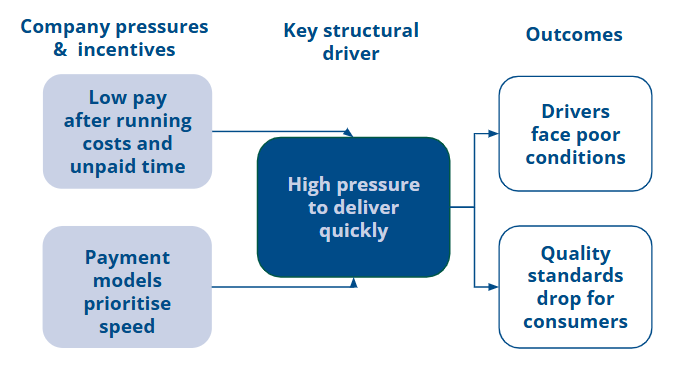
In short, time pressure remains a structural driver of poor outcomes. This research found that drivers in the sample only have 3 minutes and 9 seconds to drop off a parcel on average – including travel between points, parking and exiting the car, finding the parcel and address, and waiting for the consumer at the door. Rules around policies and training alone, even if properly designed and implemented, may not improve experiences for disabled consumers if underlying speed-focused pay structures remain.
Next steps: Regulatory fixes and employment reforms are both needed
The heart of the problem
At its core, this research examined whether self-employed delivery drivers in the parcels market work under conditions and with incentives that align with their customers' needs and priorities. We know that people value reliability above speed when asked about trade-offs in parcel delivery. But the models developed by parcel companies, which govern driver behaviour, set up the inverse. We found they are racing against the clock and barely able to secure decent pay, which is squeezed by costs and unpaid working time.
At the same time, people lack switching power in this market - we found over three quarters of parcel customers had no choice in the company carrying out their delivery. This makes it even more important that legal and regulatory standards should be set up to bring customer priorities and driver incentives into better alignment. Allowing extra time at each doorstep would mean drivers can deliver more parcels in hand, ensure those with accessibility needs see those met, and prevent purchases from going missing.
Working conditions in the postal market and their impact are already being discussed in parliament. In its recent report, the Business and Trade Select Committee instructed the Secretary of State for Business and Trade to present proposals for “levelling the playing field between Royal Mail and its competitors” – including ensuring they are not “able to undercut employment conditions through gig economy models”. We would recommend that these proposals also consider and reflect the impact of employment models on consumer outcomes in the market.
Creating a market that works for everyone
As this research has demonstrated, consumer outcomes and working conditions are fundamentally linked in the parcel market. Currently, both delivery drivers and consumers are paying the price for structural problems.
Responsibility for addressing these issues is split between two bodies: Ofcom as regulator oversees postal quality standards, while direct control over employment rights rests with the Department for Business, Innovation, Science and Trade (DBIST).
There are steps Ofcom can take within its existing remit. Setting effective and appropriate quality of service standards and enforcing these more consistently would encourage parcel companies to adjust business models to meet them, recalibrating quality alongside speed and volume.
Likewise, the risks around health and safety and the pressures on living standards identified in this research show the need for reforms to pay and working conditions in the postal sector. We welcome the government’s commitment to taking action on self-employment issues and we must see this intention translate into effective reforms.
Action is needed in both areas. Given self-employed drivers' lack of job security and leverage, there is a clear risk that higher regulatory standards alone could simply result in greater pressure on those carrying out doorstep deliveries, without improving working conditions. Meanwhile, if employment conditions improve, we still need to see more emphasis from the regulator on quality of delivery to effectively drive up performance in an area of the market where consumers have no switching power.
Measures within Ofcom’s power
1. Ofcom must strengthen Consumer Protection Condition 5, and look at payment models when investigating why disabled customers’ delivery needs are not being met
Currently, this condition requires parcel operators to possess, publish, and monitor a policy on treating disabled customers fairly. This must include options for disabled consumers to share their specific delivery needs, such as needing more time to get to the door, or making sure a parcel isn’t blocking a doorway. The regulation also requires that any “relevant employees” must be trained on the companies policy and how to comply with it. In the case of delivery drivers, this would likely be how to deliver parcels to customers who have shared particular accessibility requirements.
However, only one of the 50 self-employed drivers in this research had been trained on accessibility needs, so something is going wrong. “Relevant employees” in the condition is defined as “any employee or worker (within the meanings of those expressions under section 230 of the Employment Rights Act 1996)” – which does not cover self-employed workers, who fall outside the section 230 definition. Since many parcel companies have self-employed drivers, this creates a clear loophole that companies may be using to avoid training their drivers. Whatever the reason, it’s clear drivers aren’t receiving proper training. Ofcom must close this loophole and ensure every driver is required to have proper training, regardless of employment status.
However, training alone will not address the incompatibility between delivery target requirements and the time needed to meet additional accessibility needs on the doorstep. To address this, Ofcom should also strengthen the Condition to explicitly require companies to build in longer time margins for deliveries where there are accessibility requirements, and to demonstrate to the regulator how their payment models support this.
2. Ofcom should apply Essential Condition 1 to all postal operators.
Essential Condition 1 requires Royal Mail as the Universal Service provider to take certain actions to ensure that mail is not lost, damaged, or stolen. Royal Mail has either come top or second in our ranking of the five largest parcel delivery firms each year since our league table began in 2021. After our Parcel League Table 2025 confirmed there was no substantive decline in the general rate of delivery problems across the market for five years, we called for Essential Condition 1 to be applied to all parcel providers.
Extending this condition would hold all parcel companies accountable for preventing loss, damage, and theft. Ofcom’s latest User Experience Tracker shows 16% of consumers had a parcel not delivered and 15% had a parcel damaged in the last six months, demonstrating that loss and damage remain serious issues in the market. This research also highlights the ways in which business models focused solely on speed and volume can contribute to these issues.
Enforcing these regulatory requirements across the market could deter companies from focusing solely on strict time limits and volume targets, and instead consider how to offer drivers the time and training to deliver in a secure way wherever possible.
Changes to employment rights
3. The Government/DBIST should implement a Single Worker Status, and ensure there are effective routes to status enforcement.
Even if Ofcom strengthens regulatory requirements, there are still risks related to the structure of employment in the postal sector. A workforce heavily reliant on self-employed labour, precarious contracts and minimal worker voice could simply see these regulations translating into increased pressure on frontline couriers. We already see cases of drivers working long hours for low pay after costs, working while sick, and unable to take breaks. The conditions already pose health and safety risks, which could worsen were this pressure to increase. This research has also raised questions about whether some of the benefits of being self-employed, such as flexibility and the ability to work for multiple employers, are consistently applied in this sector.
All of this suggests that improved regulations designed to support consumers’ priorities should be accompanied by a review of worker rights and status.
The Government has pledged to consult shortly on measures to tackle self-employment issues. They must now move forward to implement new primary legislation to sharpen the distinction between employees and those who are genuinely self-employed. In the parcel market, this would likely mean that more drivers regularly doing delivery rounds are hired as employees.
This change would grant more delivery drivers entitlement to the National Minimum Wage, greater job security, and statutory benefits - something our research shows is urgently needed. Paying drivers according to their working hours would help weaken the link between pay and speed, while guaranteed working hours and greater job security would offer stronger protections for drivers facing unrealistic targets. In turn, strengthening these employment conditions would remove many of the barriers we have identified to improving service quality.
This research also raised concerns about proper enforcement of the current status rules. It found examples of self-employed drivers whose working hours lacked flexibility and where businesses restricted who drivers could work for. Although this research was not primarily designed to identify bogus self-employment, these findings add to existing concerns.
DBIST should thoroughly examine employment conditions in the sector and ensure there are effective routes to enforcement, where misclassification could be at play. Currently, enforcement can only be done through the courts, which can be long, costly, and risky for individuals who may fear reprisals from their employer. We have previously called for the government’s new Fair Work Agency (FWA) to receive powers to determine whether businesses are using the correct employment status for their staff.
DBIST can give the FWA these new powers without needing new primary legislation, as the Employment Rights Act allows the Secretary of State to extend its remit through secondary legislation. Even if status rules are strengthened, workers will still need practical and effective routes to be able to enforce them.
Endnotes
[1] Ofcom’s 2025 User Experience Tracker shows 26% of consumers had a parcel left in an inappropriate location, 16% of consumers had a parcel not delivered, and 15% had a parcel damaged in the last six months, demonstrating that loss and damage remain serious issues in the market.
[2] Citizens’ Advice 2025 Parcel League Table shows that over half (56%) had a delivery problem with their last parcel delivery, compared to 37% of the general population.
[3] Yonder Data Solutions conducted an online survey on behalf of Citizens Advice of 2,080 UK adults aged 18+ between 7-8 July 2025. Data were weighted to ensure the survey was representative of all UK adults aged 18+.
[4] This research evaluates pre-tax pay and does not model the tax differences between self-employed drivers and employees earning the NMW. How much drivers would pay in tax varies based on a variety of factors – working hours, total earnings, and whether a driver has other sources of income. Self-employed workers pay a lower National Insurance rate and can deduct running costs from taxable profit. This does not mean that running costs are fully recouped but they will not be liable to pay tax on the value of those expenses. Conversely, self-employed workers receive no employer-funded statutory benefits – such as sick pay, holiday pay, and pensions – which they must fund independently. An estimation of the value of these unfunded statutory benefits is provided in the full report by Spark Insight 947 KB .
[5] See note 4, above.
[6] Consumer Protection Condition 5 requires that any “relevant employees” must be trained on the company's “policies and procedures for the fair and appropriate treatment of disabled consumers” and how to comply with it. However, “relevant employees” in the condition is specifically defined as “any employee or worker (within the meanings of those expressions under section 230 of the Employment Rights Act 1996)”. This definition does not cover self-employed workers, who fall outside the section 230 ‘employee’ and ‘worker’ categories.